



Post Office Box 1479
Lansdale, Pennsylvania 19446-5422


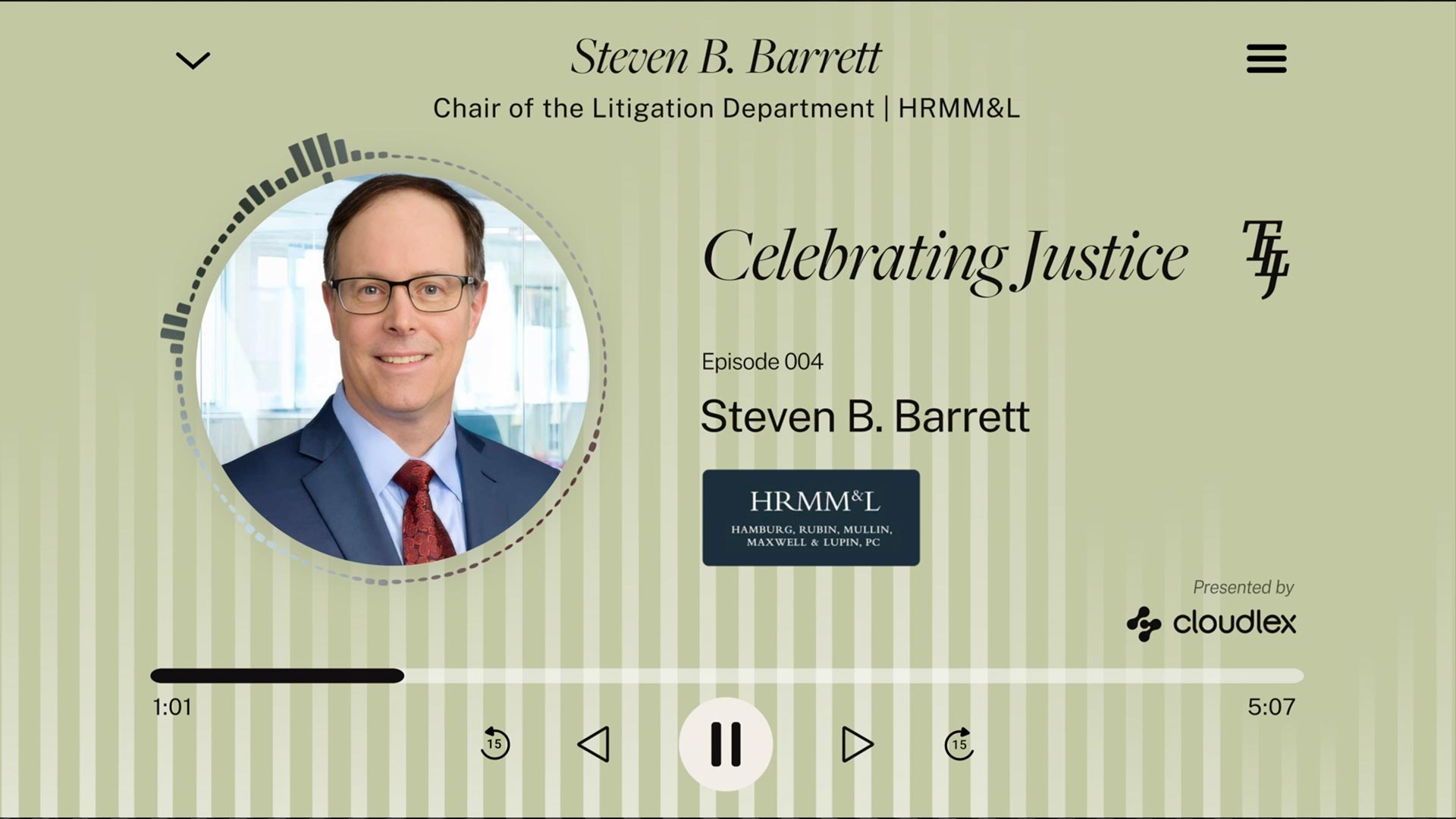
Steven Barrett’s “Closing Argument”



Frequently Asked Questions about Steven Barrett
Why did Steven Barrett want to become a trial lawyer?
At the University of Michigan, Steven Barrett first planned on medicine, then decided the crowded premed “torture test” was not for him. Raised in a progressive Jewish household by educators, he briefly considered becoming a Reform rabbi — until he called his mother with the news and she laughed. Law combined what he wanted: helping people, writing and speaking. He gravitated to trial work because, as the youngest of five sons, he had learned to read emotional and physical cues others overlook.
What makes Steven Barrett different from other personal injury lawyers?
Colleagues and opposing counsel have told Barrett that when he speaks to a jury, people simply believe him, and he calls that believability the biggest factor a trial attorney needs beyond preparation. He cultivates it outside court, greeting cashiers by the name on their tags, and brings the same habit into trial: taking notes on what jurors do for a living and then asking a witness, for example, whether he is really telling “juror number seven, the engineer” his version of events.
What case does Steven Barrett still think about?
The case that nearly drove Barrett from the law was not a personal injury matter. He represented a young couple whose basement flooded after they bought a home. Called to trial in Philadelphia the week before Labor Day, his firm was recused on a defense motion built on a decade-old letter his partner had written for a group of brokers; the judge, he later learned, wanted to return to the shore. His clients had spent nearly $30,000. He sought reconsideration, lost and refunded half their fees.
What is Steven Barrett’s “Closing Argument”?
Barrett warns against what he calls “lawyerly inertia” — the tendency of experienced lawyers to assume they know how a case will end from the core facts and the law they have mastered. As chair of his firm’s litigation department, he tells associates to take the extra deposition, question the corporate representative or track down the critical eyewitness even when it seems unnecessary. He says it is a “case changer,” and clients have come to tears when the added evidence confirmed what they had been saying.
What types of cases does Steven Barrett handle, and where is his firm?
Barrett is a principal at Hamburg, Rubin, Mullin, Maxwell & Lupin in Lansdale, Pennsylvania (hrmml.com), where he co-chairs the litigation department and chairs the personal injury practice group. Over more than three decades he has represented people who suffered catastrophic losses through negligence, focusing on medical malpractice, personal injury, sexual assault and abuse cases, constitutional claims involving police misconduct and asbestos litigation. He practices in Southeastern Pennsylvania, with results in Montgomery County, Bucks County and Philadelphia.
What notable results has Steven achieved for clients?
Since 2005, Barrett has secured settlements and verdicts totaling more than $100 million. His results include a $7 million jury verdict in Montgomery County for the estates of a married couple killed in an auto accident, a $5 million Philadelphia jury verdict for a man suffering from asbestosis, a $1.7 million Philadelphia verdict for the family of a man who died of asbestos-related esophageal cancer, a $1.2 million settlement for two teenagers severely injured in a Bucks County auto accident and a $1.1 million medical malpractice award.
Where did Steven Barrett go to law school, and where is he admitted to practice?
Barrett earned a Bachelor of Arts from the University of Michigan in 1987 and his J.D. from Temple University School of Law in 1992, the same year he was admitted to the Pennsylvania bar. He is an appointed member of the Pennsylvania Supreme Court Disciplinary Hearing Committee, a past president of the Montgomery Bar Association’s Young Lawyers Division and a former member of the association’s board of directors. He also belongs to the Pennsylvania Association for Justice and the Pennsylvania Bar Association.