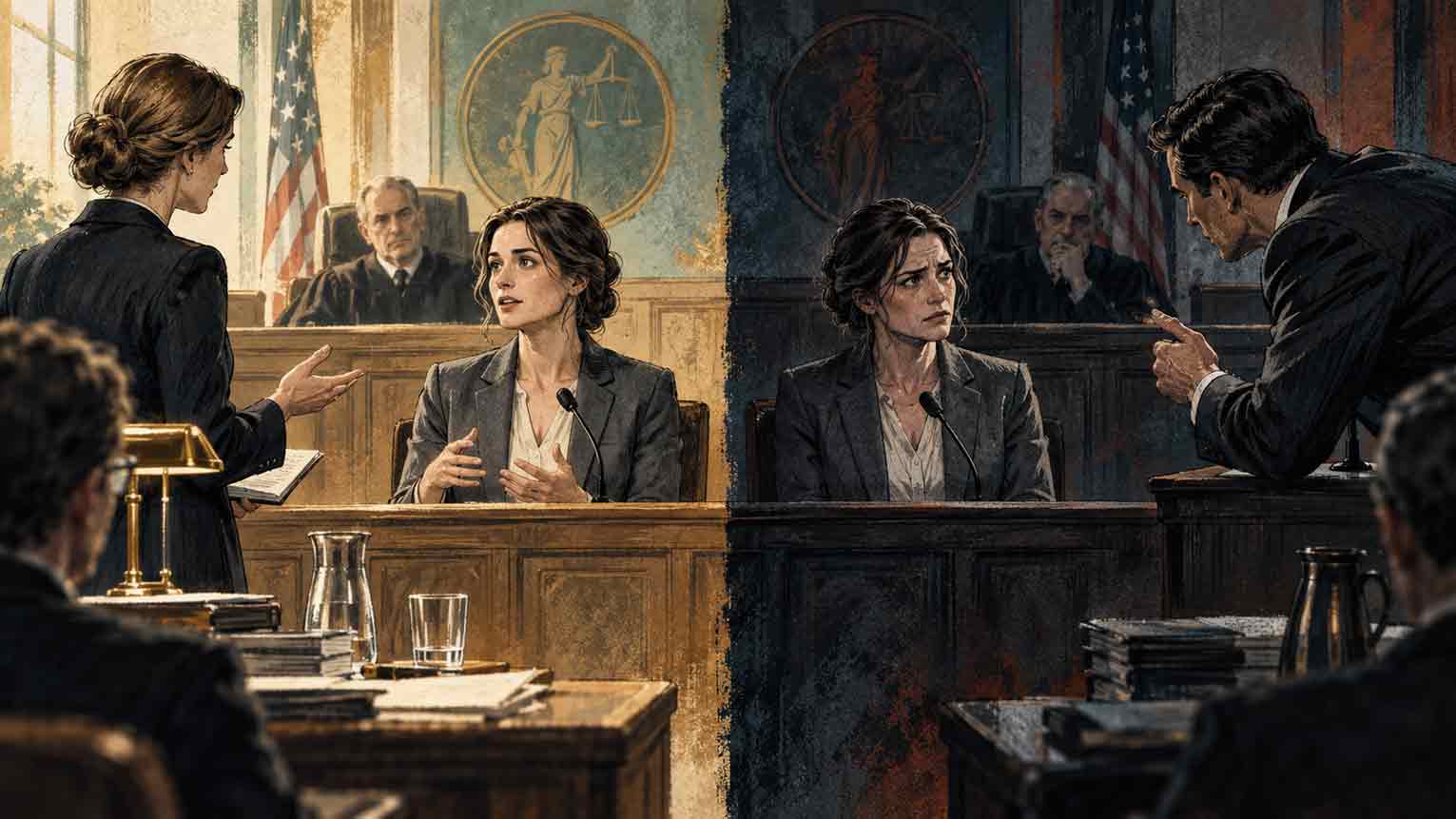
Direct examination is the questioning of a witness by the party who called them, while cross-examination is the questioning of that witness by the opposing party. The central difference lies in leading questions: direct examination generally prohibits them under Federal Rule of Evidence 611, whereas cross-examination allows them.
This article explains what direct examination is, what cross-examination is, how leading questions and scope distinguish the two and how impeachment fits into the process. Understanding the mechanics of each is the foundation of trial advocacy and a staple of evidence courses and the bar exam.
What Is Direct Examination?
Direct examination is the initial questioning of a witness by the attorney who called that witness to testify. Its purpose is to elicit the witness’s account in the witness’s own words, building the calling party’s case fact by fact. Because the witness is presumed friendly to the calling party, the rules generally bar leading questions — questions that suggest their own answer — so that the testimony comes from the witness rather than the lawyer.
The art of direct examination lies in asking open-ended questions that let the witness carry the narrative. “What happened next?” is proper; “You then saw the truck run the red light, correct?” is not, because it puts the answer in the witness’s mouth.
- The calling party conducts direct examination first, before any cross.
- Non-leading, open-ended questions are the rule under FRE 611(c).
- Leading questions are permitted on direct in limited situations — preliminary matters, hostile witnesses or witnesses with difficulty communicating.
- The goal is to develop the witness’s testimony as substantive evidence supporting the case.
What Is Cross-Examination?
Cross-examination is the questioning of a witness by the opposing party after direct examination is complete. Its purpose is to test the witness’s testimony — probing accuracy, memory, bias and credibility — and to elicit favorable facts the direct examination omitted. Here, leading questions are the primary tool, allowing the cross-examiner to control the witness and confine answers to “yes” or “no.”
Cross-examination is often called the greatest legal engine ever invented for the discovery of truth, a phrase drawn from Wigmore’s treatise. Its power comes from control: the lawyer, not the witness, shapes the exchange and a well-built series of leading questions can dismantle testimony that seemed solid on direct. The right to confront and cross-examine adverse witnesses is also a bedrock feature of the adversarial system, protected by the Confrontation Clause in criminal cases and treated as fundamental to a fair trial in civil ones.
- The opposing party conducts cross after the direct examination concludes.
- Leading questions are freely allowed and are the standard technique.
- Cross is the primary vehicle for witness impeachment, attacking credibility through prior inconsistent statements, bias or contradiction.
- Effective cross typically seeks concessions on narrow points rather than open-ended explanations.
How Do Leading Questions and Scope Differ Between the Two?
The two examinations differ most in leading questions and in the permissible scope of inquiry. Leading questions are barred on direct but allowed on cross, and the subjects a lawyer may explore are broad on direct but generally limited on cross to the matters raised during direct and to the witness’s credibility. These two variables — form of question and scope — define the practical experience of each examination.
The table below summarizes the core distinctions under the Federal Rules; state rules are largely similar but vary at the edges.
| Feature | Direct Examination | Cross-Examination |
|---|
| Who questions | Party who called the witness | Opposing party |
| Leading questions | Generally prohibited (FRE 611(c)) | Generally allowed |
| Scope | Broad — the party’s affirmative case | Limited to the subject of direct and credibility (FRE 611(b)) |
| Primary goal | Elicit the witness’s narrative | Test and impeach the testimony |
| Question style | Open-ended (“what,” “how,” “why”) | Closed, suggestive, controlling |
- On direct, the witness talks; on cross, the lawyer effectively testifies through controlled questions.
- Federal scope of cross is confined to the subject matter of the direct plus credibility, though courts may permit broader inquiry in their discretion.
- After cross, the calling party may conduct redirect examination, limited to matters raised on cross.
- The sequence — direct, cross, redirect, recross — repeats for each witness.
How Does Impeachment Work on Cross-Examination?
Impeachment on cross-examination is the process of attacking a witness’s credibility to persuade the jury to discount the testimony. The cross-examiner may confront the witness with prior inconsistent statements, expose bias or a financial interest, highlight faulty perception or memory or introduce contradictory evidence. Because leading questions are permitted, impeachment is tightly controlled: the lawyer frames precise propositions and asks the witness only to confirm or deny them.
A common technique uses a prior statement from a deposition to confront a witness whose trial testimony has changed, forcing a choice between contradicting the sworn record and conceding the point. Whatever the method, the cross-examiner rarely asks a question without knowing the answer.
- Establish the witness’s current trial testimony clearly.
- Confront the witness with the source of impeachment — a deposition, document or prior statement.
- Commit the witness to the inconsistency, bias or gap.
- Reserve the significance of the impeachment for closing argument rather than arguing it during cross.
Impeachment is also aided by trial safeguards that keep testimony independent, such as the witness sequestration rule, which prevents witnesses from conforming their accounts to one another before they take the stand. A witness who has not heard the other testimony is far more likely to contradict it, giving the cross-examiner the raw material for impeachment.
Conclusion
Direct examination and cross-examination are the two halves of every witness’s testimony, and they operate under mirror-image rules. Direct belongs to the calling party, forbids leading questions and elicits the witness’s own account; cross belongs to the opponent, permits leading questions, and tests that account through a scope limited largely to the direct and to credibility. Impeachment lives on cross, where control of the witness is the whole game. Trial lawyers who internalize these distinctions — and the FRE 611 rules behind them — question witnesses cleanly and object accurately. Because scope rules vary, confirm your jurisdiction’s approach before trial.
Frequently Asked Questions