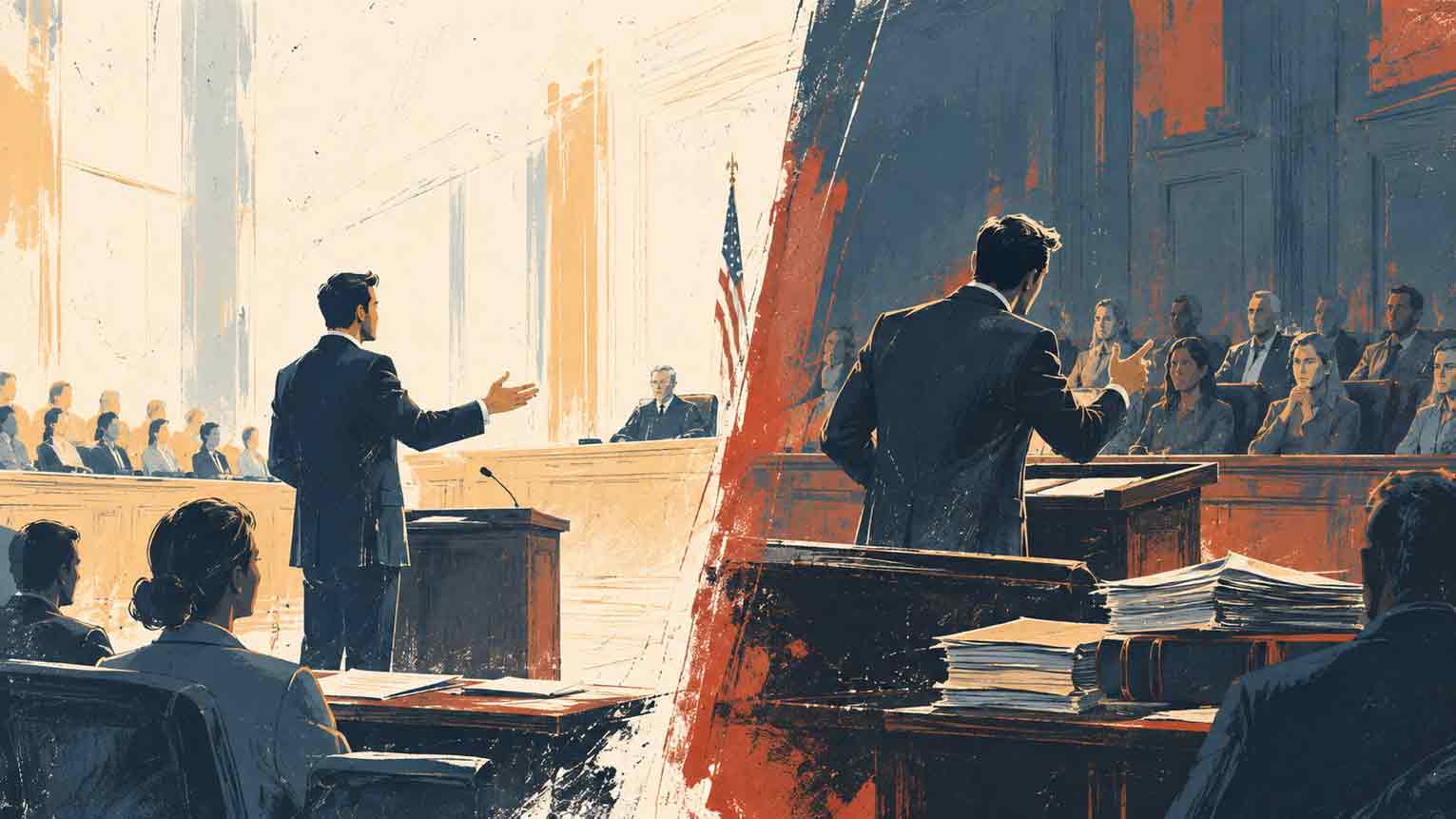
An opening statement is a lawyer’s preview of the evidence at the start of trial, while a closing argument is the persuasive summation delivered after the evidence is in. The key difference is argument: opening statements outline what the proof will show, whereas closing arguments argue what the proof means and urge a verdict.
This article explains what an opening statement is, what a closing argument is, how the two differ in purpose and permissible content and where the ethical lines fall for each. The distinction is fundamental to trial practice and a frequent source of sustained objections when a lawyer blurs it.
What Is an Opening Statement?
An opening statement is the address each side gives at the beginning of trial to tell the jury what the evidence will show. It comes after jury selection and before the first witness, and its purpose is to give jurors a roadmap so they can follow the proof as it unfolds. Crucially, an opening statement is not supposed to be argument — counsel previews the facts they expect to prove but does not yet urge conclusions or attack the opponent’s case.
The classic formulation is that an opening statement tells a story of what the evidence will reveal, without pausing to argue why the jury should side with the speaker. Lawyers who cross that line invite the objection “argumentative,” and courts sustain it.
- It follows voir dire and precedes the presentation of evidence.
- It outlines the anticipated facts, witnesses and exhibits rather than arguing their significance.
- The plaintiff or prosecution goes first; the defense may open immediately after or, in some courts, reserve until its own case.
- Improper argument, references to inadmissible evidence or promising proof counsel cannot deliver all draw objections.
What Is a Closing Argument?
A closing argument is the summation each side delivers after all the evidence has been presented, arguing how the jury should interpret that evidence and what verdict it should return. Here, argument is not only permitted but expected: counsel may draw inferences, attack credibility, highlight contradictions, and, in a civil injury case, propose a specific damages figure. The closing is the one moment when a lawyer can openly tell the jury what the proof means and why it compels a result.
Because the evidence is closed, counsel is confined to what the record actually contains, but within that record the advocate has wide latitude to persuade. Closings typically precede or follow the court’s jury instructions, depending on the jurisdiction and often track the legal elements the jury must find. A well-structured closing organizes the evidence around those elements, showing the jury how each admitted fact satisfies a piece of the legal test it has been asked to apply.
- It occurs after both sides rest and before or just after the jury is instructed.
- Counsel may argue inferences, credibility and the weight of the evidence.
- In civil cases, the plaintiff may argue damages, including a specific number, subject to local limits on that practice.
- The party with the burden of proof usually argues first and receives a rebuttal after the opponent’s closing.
What Is the Key Difference Between the Two?
The key difference is that an opening statement previews the evidence without argument, while a closing argument interprets that evidence and advocates for a verdict. The two bookend the trial and serve opposite functions: one orients the jury before it has heard anything, and the other persuades the jury after it has heard everything. Confusing the two — arguing in opening or introducing new facts in closing — is one of the most common trial errors.
The table below sets out the core distinctions side by side.
| Feature | Opening Statement | Closing Argument |
|---|
| Timing | Start of trial, before evidence | End of trial, after evidence |
| Core purpose | Preview the facts, give a roadmap | Argue the meaning of the evidence |
| Argument allowed | No — no inferences or conclusions | Yes — inferences, credibility, advocacy |
| Damages figure | Generally not argued | May be proposed, subject to local rules |
| Reference to evidence | To what will be proved | To what was actually proved |
- Opening is descriptive; closing is persuasive.
- Opening looks forward to evidence not yet heard; closing looks back at the completed record.
- New factual assertions are proper in neither — opening previews the record, closing is confined to it.
- Both are commentary by counsel, not evidence, and jurors are instructed accordingly.
What Can Lawyers Not Say in Either One?
In both openings and closings, lawyers may not misstate the law, refer to evidence outside the record or make certain forbidden appeals to the jury. The most notable prohibition is the Golden Rule argument, which asks jurors to place themselves in the plaintiff’s position and award what they would want for their own suffering — improper in nearly every jurisdiction. Personal attacks on opposing counsel, appeals to passion or prejudice and comments on a party’s failure to testify where barred are likewise off-limits.
The permissible scope differs because the purposes differ, but the outer ethical boundaries apply to both. A lawyer who breaches them risks a sustained objection, a curative instruction, or, in serious cases, a mistrial.
- Neither may misstate the applicable law or the court’s instructions.
- Neither may reference facts not admitted into evidence, and opening may not promise proof that never arrives.
- The Golden Rule argument is improper in both, as are appeals purely to sympathy, passion or prejudice.
- Openings additionally bar argument itself, a restriction that does not apply to closings.
Conclusion
The difference between an opening statement and a closing argument comes down to argument and timing: the opening previews the evidence to orient the jury, and the closing argues that evidence to persuade the jury. Both are the words of counsel rather than evidence, both are confined to the record the trial produces, and both are bounded by prohibitions on misstating the law and on improper appeals like the Golden Rule. Trial lawyers who keep the two functions distinct — roadmap first, argument last — present cleaner records and draw fewer objections. Confirm your jurisdiction’s rules on damages arguments and the sequence of instructions before trial.
Frequently Asked Questions