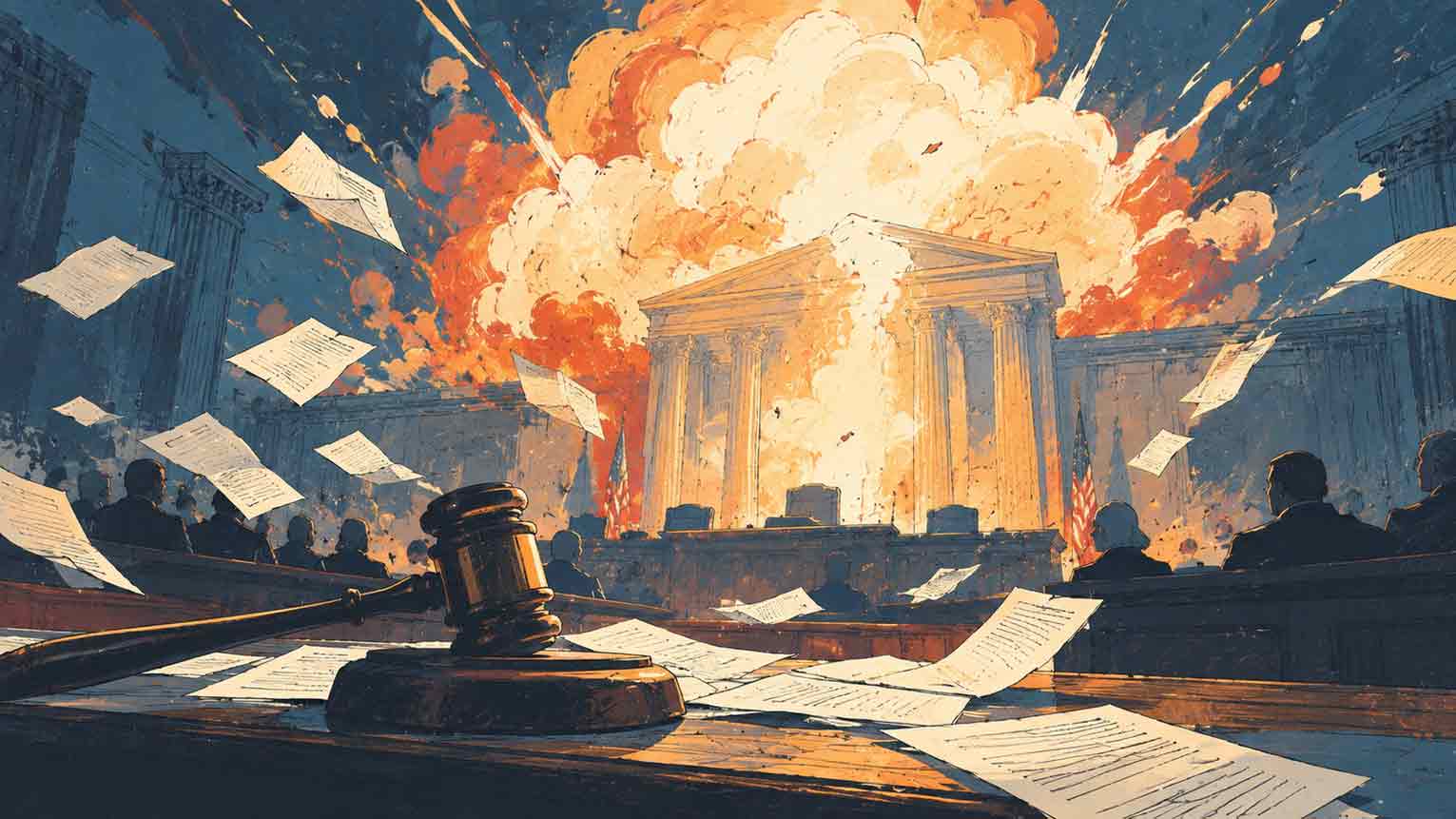
A nuclear verdict is a jury award of $10 million or more, typically in a personal injury or wrongful death case, that far exceeds what the facts would ordinarily predict. The term describes both the size of the award and the perception that it reflects jurors’ anger at a defendant rather than pure economic loss.
This article explains what a nuclear verdict is, why these awards have become more common, how they are calculated and what the surrounding legal debate means for injury litigation. The phrase has moved from insurance conference rooms into mainstream news, and understanding it — neutrally, without the spin from either side — matters for anyone following the modern fight over damages.
What Does “Nuclear Verdict” Mean?
A nuclear verdict is an exceptionally large jury award, most often defined as $10 million or more, that dwarfs the amount a case would typically command. The label was popularized by defense attorney Robert Tyson and has since become shorthand across the insurance and legal industries for awards seen as disproportionate to the underlying harm. When an award reaches $100 million or more, commentators sometimes call it a “thermonuclear verdict.”
The term is descriptive rather than legal — no statute defines it and no court issues a “nuclear verdict” as such. It captures a perception as much as a number: that the award reflects a jury’s desire to punish or send a message, not just to compensate. Because the phrase originated on the defense and insurance side, plaintiff attorneys often note that a large award can also be the accurate price of a catastrophic, permanent injury.
- The common threshold is $10 million or more, though the figure is a convention, not a rule.
- A “thermonuclear verdict” generally refers to an award of $100 million or above.
- The term is used by insurers, defense counsel and the media, and carries a built-in point of view.
- A large verdict is not automatically excessive; severity of injury can justify a very high number.
What Causes Nuclear Verdicts?
Nuclear verdicts result from a combination of severe injuries, sympathetic plaintiffs, unpopular corporate defendants and persuasive damages advocacy — not any single factor. Analysts point to a broader social shift, sometimes called “social inflation,” in which jurors are more willing to hold large companies accountable with very large numbers. Skilled use of damages strategy amplifies that willingness, giving jurors a concrete figure to rally around.
Several forces tend to appear together in the cases that produce these awards:
- A catastrophic or fatal injury that generates genuine sympathy and real lifelong costs.
- A corporate or commercial defendant that jurors perceive as prioritizing profit over safety.
- Persuasive plaintiff strategy, including anchoring — placing a specific large figure before the jury — and reptile theory, which frames the defendant as a danger to the community.
- Rising public distrust of corporations, which lowers jurors’ resistance to eight- and nine-figure numbers.
Damages arguments matter because so much of a large award is noneconomic — pain and suffering that has no invoice. When jurors have no market price for a lost life or a shattered spine, the numbers advocates suggest carry outsized weight.
What Are Examples of Nuclear Verdicts?
Nuclear verdicts appear across trucking, product liability, medical malpractice and premises cases and the largest have reached into the billions. Recent years have seen record awards against motor carriers after fatal highway crashes, against manufacturers of products alleged to cause cancer and against companies accused of ignoring known hazards. Many are later reduced by trial judges or on appeal, so the announced number is not always the amount ultimately paid.
Common settings for these awards include:
- Commercial trucking crashes, where a fatal collision and a corporate defendant combine to drive very large awards.
- Product liability cases, especially mass-tort litigation over pharmaceuticals, chemicals and consumer products.
- Medical malpractice cases involving death or catastrophic, permanent disability.
- Premises liability and negligent-security cases where a company allegedly ignored a foreseeable danger.
It is important to read these headline figures with care. A verdict may include a large punitive damages component, which is subject to constitutional limits, and many states impose a statutory damages cap that reduces the award after trial. The number announced in the courtroom is frequently not the number that survives post-trial review.
How Do Nuclear Verdicts Affect Personal Injury Cases?
Nuclear verdicts influence far more than the single case in which they occur — they shape settlement values, insurance pricing and the political fight over tort reform. A widely reported large award raises expectations on both sides of future negotiations, and insurers cite these verdicts when justifying higher premiums and when pressing legislatures for new limits on damages. That feedback loop is now a central theme in civil justice policy.
For the litigants themselves, the practical impact is concrete:
- After a large verdict, defendants often move for remittitur, asking the judge to reduce an award found excessive or pursue an appeal.
- Statutory caps and constitutional limits on punitive damages can shrink the final judgment substantially.
- The prospect of a nuclear verdict changes settlement leverage long before trial, encouraging some defendants to settle and others to fight harder.
- Tort-reform proposals — caps, limits on anchoring, and changes to how damages are argued — are frequently framed as responses to these awards.
The debate itself is genuinely contested. Defense and insurance groups argue that nuclear verdicts reflect runaway juries and unsupported numbers, while plaintiff advocates counter that large awards are sometimes the only accurate measure of a devastating, permanent loss and the only real deterrent for a negligent corporation. A neutral understanding of the term holds both ideas at once: the size of an award is not, by itself, proof that it is wrong.
Conclusion
A nuclear verdict is a jury award of roughly $10 million or more that stands out for its size and for the perception that it reflects a jury’s judgment about a defendant, not just a plaintiff’s losses. These awards arise from a mix of severe harm, unsympathetic defendants and effective damages strategy, and they ripple outward into settlement values, insurance rates and the tort-reform debate. Whether a given nuclear verdict is excessive or simply accurate is a fact-specific question — one that courts, not headlines, ultimately decide. Anyone navigating a serious injury claim benefits from understanding how these awards are built, challenged, and, often, reduced and from speaking with an experienced personal injury attorney about what a case is realistically worth.
Frequently Asked Questions