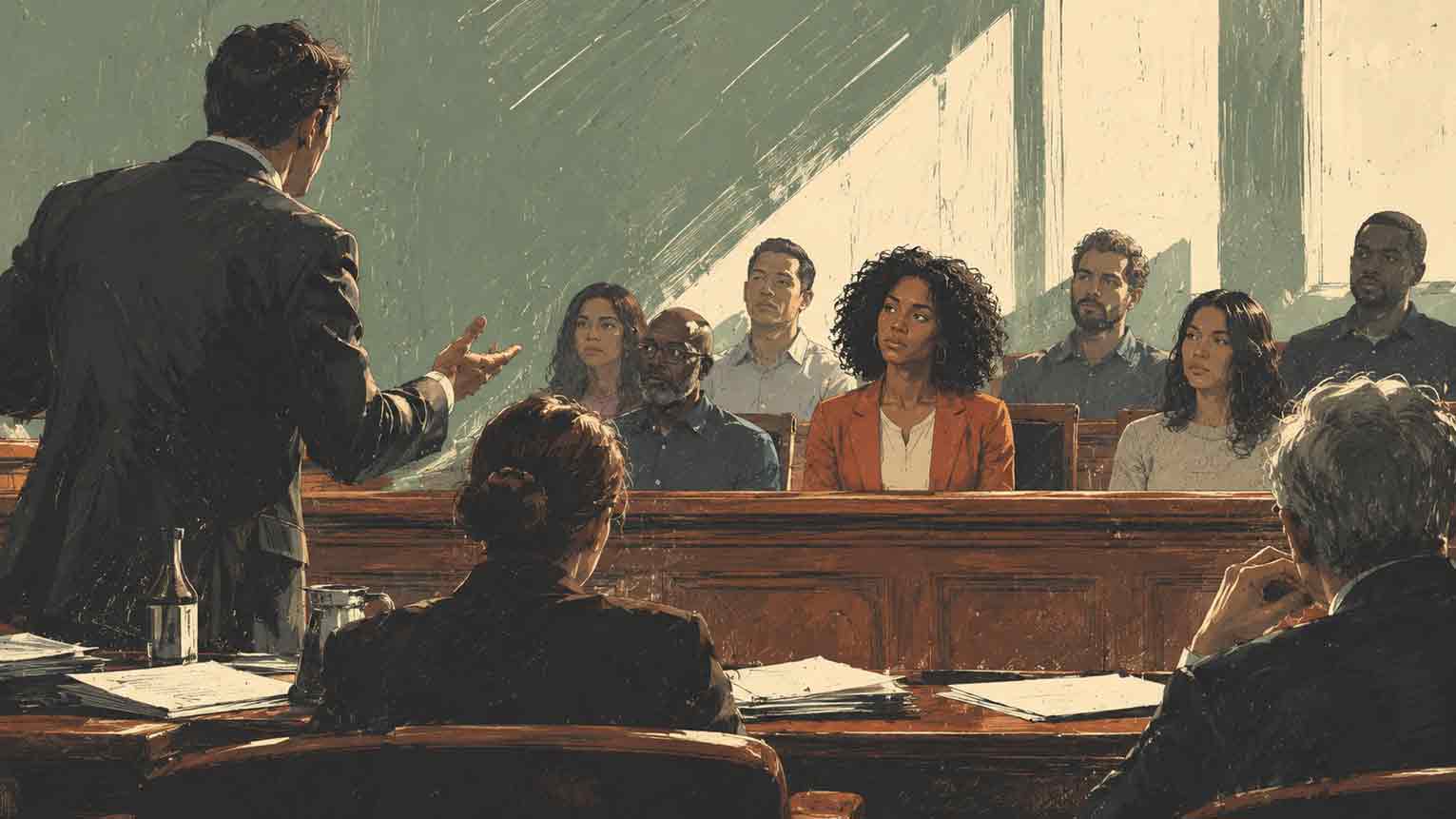
A Batson challenge is an objection raised during jury selection when one party believes the other is using a peremptory strike to remove a potential juror because of race, ethnicity or gender. Named for the U.S. Supreme Court’s 1986 decision in Batson v. Kentucky, it lets a party ask the court to require a discrimination-free reason for the strike.
This article explains what a Batson challenge is, the constitutional basis for it, the three-step process courts use to resolve one and how the doctrine has expanded since 1986. Jury selection is where many trials are quietly won or lost, and the rules against discriminatory strikes are a core part of that contest for both civil and criminal practitioners.
What Does a Batson Challenge Mean?
A Batson challenge is a formal objection that a peremptory strike — a party’s removal of a prospective juror without stating a reason — is actually being used to discriminate on the basis of a protected characteristic. Ordinarily, each side may exercise a set number of peremptory strikes for almost any reason or no reason at all. Batson creates a critical exception: a peremptory challenge may not be used to exclude jurors because of race, and later cases extended that bar to ethnicity and gender.
The challenge arises during voir dire, the questioning of prospective jurors, as each side exercises its strikes. It targets the peremptory challenge specifically, because a strike for cause already requires a stated, legitimate reason. Batson asks the court to look behind a “no reason needed” strike to ensure discrimination is not the true reason.
- A Batson challenge polices peremptory strikes, not challenges for cause.
- It applies in both criminal and civil trials and can be raised by either party.
- The protected categories are race, ethnicity and gender.
- The objecting party is asking the court to demand a discrimination-free explanation.
What Is the Legal Basis for a Batson Challenge?
The Batson challenge rests on the Equal Protection Clause of the Fourteenth Amendment, which the Supreme Court held forbids striking jurors solely because of their race. In Batson v. Kentucky (1986), the Court ruled that purposeful racial discrimination in jury selection harms not only the defendant but the excluded juror and public confidence in the courts. The decision replaced an earlier, nearly impossible standard that had required proof of discrimination across many cases.
The doctrine did not stop at its original facts. A series of later decisions broadened who is protected and who may raise the objection:
- Powers v. Ohio (1991) held that a defendant may object to racial strikes even when the defendant and the excluded juror are of different races.
- Edmonson v. Leesville Concrete (1991) extended Batson to civil cases, so private litigants may not strike jurors by race.
- Hernandez v. New York (1991) applied the framework to strikes based on ethnicity.
- J.E.B. v. Alabama (1994) extended the prohibition to peremptory strikes based on gender.
Together these cases turned Batson from a criminal-defense rule into a general constitutional limit on discriminatory jury strikes, binding on prosecutors, criminal defendants and civil parties alike.
How Does the Batson Three-Step Process Work?
Courts resolve a Batson challenge through a three-step, burden-shifting process that moves from the objecting party, to the striking party and back to the judge. The framework is designed to smoke out discrimination while still allowing genuine, neutral reasons for a strike. Each step has a distinct question, and the judge’s final ruling is entitled to significant deference on appeal because it often turns on credibility.
The three steps proceed in order:
- Prima facie case — The objecting party must show facts suggesting the strike was based on a protected characteristic, such as a pattern of removing jurors of one race.
- Neutral explanation — The burden shifts to the striking party to offer a clear, specific reason for the strike that is unrelated to race, ethnicity or gender.
- Purposeful discrimination — The judge decides whether the stated reason is genuine or a pretext for discrimination, weighing the credibility of the explanation against the full record.
At step two, the reason offered need not be persuasive or even wise — it must simply be facially neutral. The real work happens at step three, where the judge compares the explanation to how the striking party treated other jurors. If a party offers a reason that applies equally to accepted jurors of another group, that inconsistency is strong evidence of pretext. A successful challenge typically results in the juror being seated or, in some courts, a remedy such as a new venire.
How Has the Batson Doctrine Expanded and Been Criticized?
The Batson doctrine has grown well beyond its 1986 origins, and it has also drawn sustained criticism for being easy to evade. Because step two requires only a facially neutral reason, striking parties can often articulate plausible-sounding explanations — demeanor, employment, body language — that are difficult to disprove. Critics across the ideological spectrum, including Justice Thurgood Marshall in the original case, warned that the framework would not fully eliminate discrimination in jury selection.
In response, some jurisdictions have moved beyond the federal standard:
- California enacted a statute (Code of Civil Procedure section 231.7) that lets a court sustain an objection without finding intentional discrimination, asking instead whether an objective observer could view the protected trait as a factor in the strike.
- Washington adopted a court rule (GR 37) using a similar “objective observer” test and presumptively invalidating certain historically suspect reasons.
- Arizona took the most sweeping step, eliminating peremptory challenges in most cases altogether.
- Several other states have studied or piloted reforms aimed at closing the gap Batson left open.
These developments reflect a broader debate about whether the peremptory challenge can coexist with equal protection at all. For practitioners, the practical takeaway is that the governing standard now varies by jurisdiction: the federal Batson test still controls in many courts, but a growing number of states apply a more demanding rule that is easier for the objecting party to satisfy.
Conclusion
A Batson challenge is the constitutional check on discriminatory jury strikes — the mechanism that forces a party to justify removing a juror when race, ethnicity, or gender appears to be the reason. Grounded in the Equal Protection Clause and refined through decades of case law, it operates through a three-step process that shifts the burden from the objector, to the striking party and finally to the trial judge. The doctrine continues to evolve, with several states adopting standards stricter than the federal baseline. For trial lawyers and law students, mastering Batson means knowing not only the three steps but also which version of the rule governs in a given courtroom, because the answer increasingly depends on the jurisdiction.
Frequently Asked Questions